The Third Dimension
Silicon Graphics Inc., a company who worked with 3D graphic-rendering, wanted to expand their work into video games. They first
redeveloped their MIPS R4000 CPU to be more power-efficient and cheaper to produce, called the R4300i. The first company SGI
approached was Sega, who were impressed with their pitch, but rejected it because of hardware issues. SGI then went to Nintendo,
a more appealing business partner, who ultimately agreed to start a partnership. So, SGI CEO Jim Clark and Nintendo CEO Hiroshi
Yamauchi got to work on "Project Reality" in early 1993. On August 23rd, the duo announced their partnership in development and
their licensing agreement. They planned to show off the unnamed system in 1994, and release it in late 1995 for under $250.
The developers tested games with an SNES controller modified to have a joystick and Z button trigger (I have yet to find a
picture of that). On June 23rd, 1994, it was named the "Ultra 64". Using the supercomputing platform Nintendo purchased from
SGI, their third-party developer base could prototype games until the system's hardware was completed. The design was then shown
to the public, and Nintendo and Midway started work on arcade games to port them to it, such as Killer Instinct and Cruis'n USA.
Nintendo was considering using CD-ROM technology for their games if the format's performance issues could be solved, but in the
end they stuck with a fast yet space-restricted cartridge format. The original plan was to name the console the "Ultra Famicom"
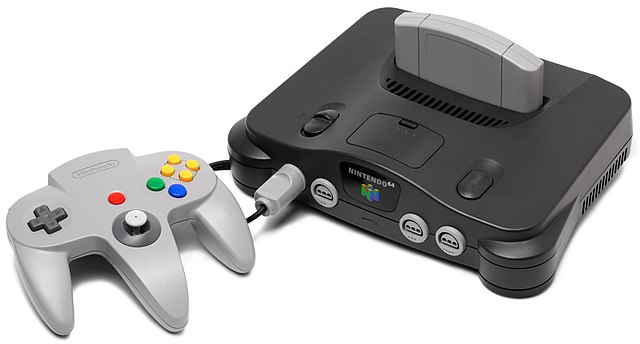
in Japan and "Nintendo Ultra 64" everywhere else. But they decided to universally name it Nintendo 64 to brand and design the
logo in a simple manner. In July 1995, the hardware was finished, and game development was moved to a console simulation board.
The Nintendo 64 was slated to come out in Christmas 1995. It was delayed to April 21 the next year to allow more time for game
development and for the hardware to mature. Then, it was delayed to and released June 23rd, 1996 (precisely two years after the
original name choice) because they felt they could not produce enough to meet demand by April.
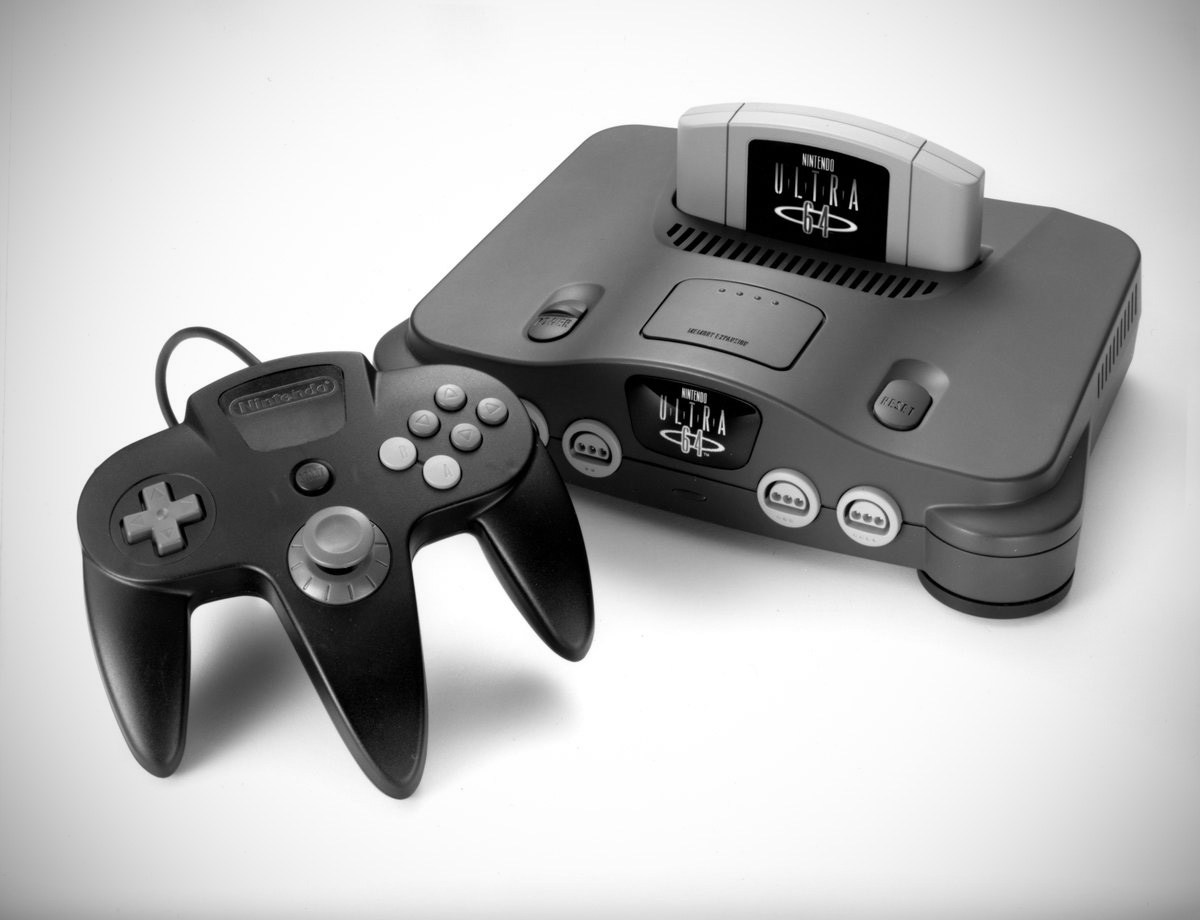
The console itself was not changed at all, besides the logo on the front, which was just a monochrome "Nintendo Ultra 64" logo.
After announcing Project Reality, Nintendo considered their choices of storage mediums. The American branch chairman Howard
Lincoln found that cartridges have faster access time, characters, and movement than CDs, despite accessing and storing
considerably less memory. They planned to introduce the main system with cartridges, and although not specifying how, issues
with CDs would be solved. With a launch price of about $90 in mind, software engineering manager Jim Merrick struggled to build
an eight-speed CD-ROM mechanism in a base console with a price under $200. They ultimately chose proprietary floppy disks, which
are middle-ground in terms of load time, memory, and production costs compared to CDs and cartridges.
Introduction
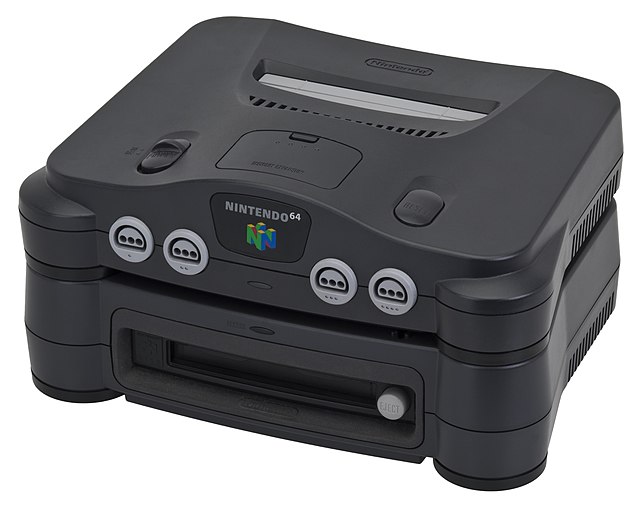
President Hiroshi Yamauchi announced the 64DD (nicknamed the "Bulky Drive") at Space World 1995, giving a 1997 Japanese release
date. But it wasn't until next Space World that the 64DD was revealed and a late 1997 release was confirmed, but the specs, yet
to be revealed, were finalized. It didn't appear to function in its glass display case, but a demo of Zelda 64 (eventually
Ocarina of Time) was shown. A demonstration of the unit used a disk with Super Mario 64 on it, and two Mario Artist to-be
programs to show its capabilities: Talent Maker (eventually Talent Studio) that maps a person's face onto 3D animated avatars,
and Creator (eventually Paint Studio), a program for making music and animations and replacing a game's textures with custom
graphics. Game developers for the add-on included Konami, Capcom, Enix, and Rare.
Procrastination
Throughout the next three years, the 64DD's release would be delayed time and time again, resulting in the axe being taken to
any possibility it would come out in the US by early 1999. Each delay would come with its own alleged reason such as problematic
disk and drive production and software programming issues, leading to very few complete launch titles for the peripheral by E3
1999 when it was fully demonstrated by Nintendo. In the years following the base Nintendo 64's release, its demand dwindled,
causing software developers to lose confidence in the 64DD. IGN also reported the Randnet and modem were finished. At Space
World 1999 in August, Nintendo set the launch date of Randnet to December 1, 1999, but no launch date for the 64DD itself. A
pre-order program had been announced for mid-September but had just been delayed to November or December.
It was released (far belatedly) on December 13th as a package "Randnet Starter Kit" which includes six games every two months by
mail, and a year of Internet service. It was sold by mail order as Nintendo forecasted the commercial failure of the peripheral.
Sadly, consumer hype for the system was mostly gone. Only around 15,000 units were sold, and in turn, 15,000 subscribers were
amassed by October 2000, and the hardware and online websites were discontinued in February 2001. To top it all off, only
10 titles were released for the 64DD. Many more were developed, but they were either cancelled entirely, released as
standard N64 cartridges, or redeveloped for the PlayStation or eventual GameCube.
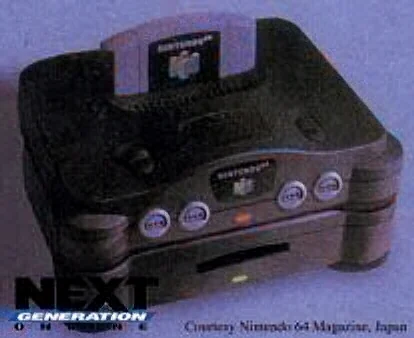
The disk input was shorter and there doesn't seem to be an eject button. Disks were shaped like 3.5" floppy disks that were used
in DOS systems. The loading light was green and underneath the slot, too.