On Bumpers and Buttons
In 1977, as pinball continued to reign amusement centers which arcade games had only just broken into, two MIT students called Doug Macrae
and Kevin Curran hung out at the arcade in their down time. Macrae's older brother gave him a pinball machine he didn't want anymore, and set
it up on campus hoping to make a little pocket change. They ended up make more than just "pocket change", inspiring Macrae and Curran to
expand to over 20 pinball machines and arcade cabinets. When Atari's Missile Command was released in July 1980, the duo purchased three of
them for their campus arcade due to how popular the game was at the time. After about a year, its success had really dried up. Most people
that played it got bored because it was repetitive and/or they just got really good at it. So Macrae and Curran decided to modify Missile
Command.
Missile Redirect
During the golden age of arcade games, a market for "enhancement kits" started to form. An enhancement kit is a circuit board that contains
a game of its own that overrides an existing board's code when plugged in. While cheaper, it sometimes crosses into gray legal territory.
Enhancement kits usually add features to the main board's game, such as enemies, weapons, power-ups, and sometimes totally replaces the game
(like Donkey Kong 3 did for Donkey Kong Jr.), so arcade owners would purchase a kit to reignite arcade-goers' interest and incline them to
insert more quarters.
With an enhancement kit for Missile Command on the mind, Macrae and Curran searched for one to purchase and place into one of those cabinets,
but the game was so complex that no one actually made one yet, so the duo set out to make their own. They filed paperwork to establish a
brand-new company called General Computer Corporation, bought a microprocessing development kit, and gathered four more programmers to work on
their new Missile Command kit called Super Missile Attack. It was such an immediate success that Macrae and Curran promptly placed ads in
magazines such as Play Meter.

A Command of Attack
However, in August 1981, arcade and home gaming titan Atari caught wind of this. They originally filed a temporary restraining order and sued
the young GCC for copyright infringement, because they modified their game without their permission. However, in earnest, they started work on
a kit for another game. They believed they made the Super Missile Attack kit a little late following the peak of Missile Command's popularity,
so the next kit would be for Pac-Man.
Pac-Human
Although Pac-Man came out around the same time as Missile Command, it still had a huge following that went as far as having songs made
about it (such as "Pac-Man Fever"), a cartoon in the works, and a bunch of ports to home consoles in the following couple of years. It was
so big, that an enhancement kit, or even a sequel, could be even BIGGER, Macrae and Curran thought. So, they analyzed the flaws that Pac-Man
had. First, the game's ghosts had movement patterns that were relatively easy to memorize. GCC fixed this by giving them random movement
patterns (I don't know if that means having the game choose one of many pre-determined patterns or if it's 100% random how they move every
time a level is started). Next, there was only one maze in Pac-Man. This caused the game to grow stale and allowed players to use mostly the
same maneuvers every time they played. So the team designed four different mazes for the new game to encourage players to play further, see
more, and develop new strategies. Then, the bonus fruits that stayed under the ghost pen in Pac-Man were made mobile, making them move about
the maze on their own to give players a risk-and-reward option by risking potentially losing a life for hundreds or thousands of extra points
by chasing after it. Finally, having learned from Atari suing GCC for their Missile Command enhancement kit, they felt the need to change
Pac-Man to someone different to avoid copyright infringement lawsuits from Namco.
They gave the character much(?)-needed legs and renamed him Crazy Otto (which suspiciously resembles Pac-Man, again, except as he's seen on
its cabinet art and fliers).

Pac Gets Lucky
Apart from the programming changes that were made, GCC saw fit to make a few minor changes to the game. One big thing was they wanted to add
to Crazy Otto's identity by having him meet a female companion, fall in love, and eventually have a baby. These three stipulations were
incorporated into the game as "cartoons" (or cutscenes in today's gaming lingo) after every few levels. Here's how they went:
After Level 2, Crazy Otto and... female, red Crazy Otto were both running away from ghosts, when they eventually locked eyes and ran away
to share a kiss.
After Level 5, the two began lovingly chasing each other off of both sides of the screen.
After Level 9, a stork flies across the sky, dropping off a small offspring "Junior" for the two Otto characters, now parents.
There's also some other minor notes about the game I think you'd like to know. GCC made a small change involving the name of the orange
monster. In Pac-Man, it was called Clyde, but for Crazy Otto it was changed to Sue, which was GCC founder Doug Macrae's sister's name! One
more change lies in the collectable fruits. In between the orange and apple in Pac-Man came the pretzel in Crazy Otto, the addition of which
is attributed to Kevin Curran's love for salty snacks!
An Unlikely Partnership
By the time GCC finished Crazy Otto in October 1981, Atari got back in contact with them, dropping the lawsuit they filed in relation to the
Super Missile Attack kit for Missile Command. They had a change of heart, believing that the team at GCC could work well with them, offering
the college dropouts a two-year partnership to work on games with them. Gawking at the unlikely opportunity to become partners with the
then-biggest video game company in the world, GCC signed on. But the very day of this agreement being signed, Macrae and Curran, in addition
to programmer Steve Golson all went to an undercover meeting with arcade publisher Midway. They were in a financial crisis that, although
Pac-Man helped make them rich in addition to Namco, didn't have a successor in the works for it in case it started to lose the interest of
gamers. And Midway called in the right people at the right time!
Foxy Pac-Lady
Midway were interested in purchasing Crazy Otto, under the sole condition that the legged-Pac-Man walk away. Midway wanted the game to feature
Pac-Man or someone like him, and for the game to be called Super Pac-Man (not to be confused with the later-1982 title of the same name). They
and GCC would end up settling on a feminine Pac-Man, drawing inspiration from the cutscenes in Crazy Otto, to star in what was just planned
out to be a full-fledged Pac-Man sequel. The next order of business was what to call this very first female video game protagonist and how she
should look. At first, the name began as Pac-Woman and featured a female Pac-Man with long red hair and blue eyes.

It was at this point the name was changed to
Miss Pac-Man. Then, it was pointed out that players could get confused about her
relationship with Pac-Man, as the pair were delivered the baby in the aforementioned third cutscene. This sparked the name
Mrs.
Pac-Man, and then came the final Ms. Pac-Man name, as it rolls off the tongue best. All these changes happened in three days!
But then, Masaya Nakamura, president of Namco who were also totally on board with the Pac-Man sequel when Midway got wind of it, chimed in and
recommended that the silly redhead be changed to a Pac-Man creature with a red bow and mole.
Pac-Matriarch
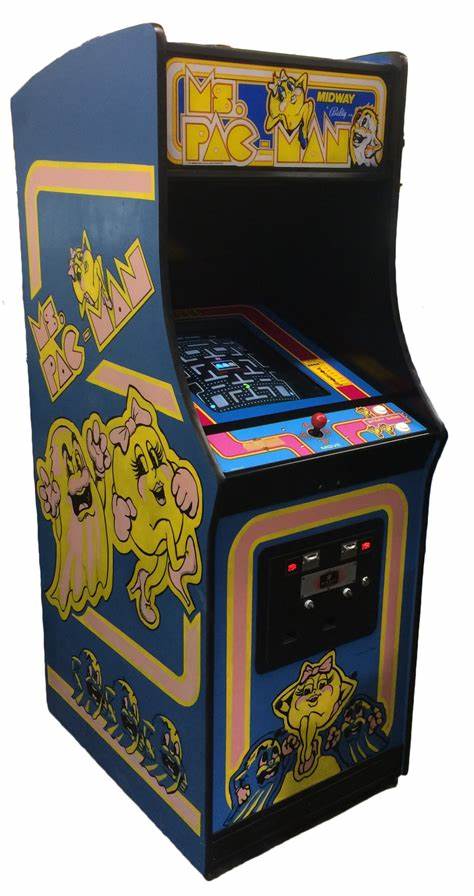
Ms. Pac-Man finally appeared in arcades for the first time on February 3, 1982. Namco felt that, as the presence of female gamers increased in
a massive order of magnitude, they felt that this game was a perfect way to thank them for their patronage.