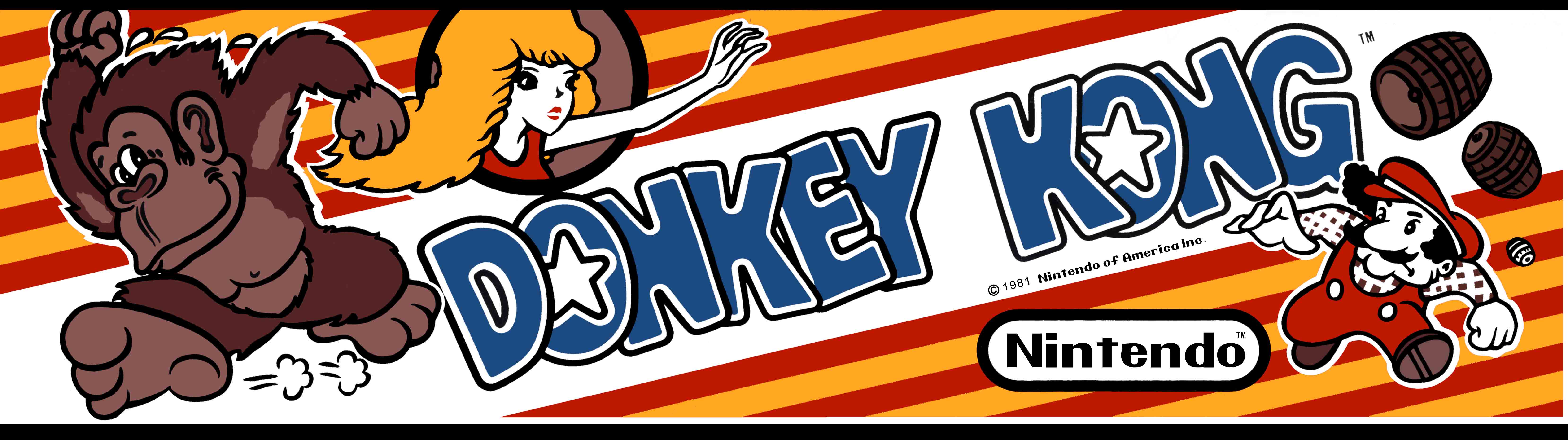
Bullets Before Barrels

In 1980, Nintendo exported arcade cabinets from Japan over to the US, which gave way to an American branch of the company. The first
order of business by newly-appointed NoA president Minoru Arakawa was for an order of 3,000 Radar Scope cabinets from Japan where the
game was mildly successful. Unfortunately, only 1,000 sold. Radar Scope was a failure, leaving 2,000 unsold machines in a warehouse.
So, with the company facing potential financial ruin, Nintendo president Hiroshi Yamauchi was asked for a new game to replace it.
Television equipment manufacturer Ikegami was tasked with programming.
Spinach Before Hammers
Two men were tasked with the creation of this new game, and little did they know how influential they would become. Shigeru Miyamoto
was made, for the first time, lead game designer and young head engineer Gunpei Yokoi was made project supervisor. Miyamoto's
trademark "out-of-the-box" perspective and thinking came out right away, as he wanted this game to be like a cartoon or comic of
sorts to make it stand out among the racing, submarine, and shoot-em-up video games that were common at the time. The original plan
was to make a platformer that involved Popeye as the main character, Bluto as the villain, and Olive Oyl as the damsel in distress.
But when Nintendo initially (foreshadowing) failed to get the license, Miyamoto decided to go for a King Kong-esque theme. The story
became a lovestruck, "stupid" ape escaping to the top of a construction site with a pretty girl in his arms. This girl happens to be
the girlfriend of a carpenter called Jumpman, who runs and jumps on girders and moving platforms, and over barrels, gaps, and
fireballs among other hazards to save her.
Silly Name for a Silly Game
Yamauchi already knew this game would not only save Nintendo's young American operation, but help further establish it. Miyamoto now
needed to come up with an English name for it, which unfortunately was a language he wasn't familiar with. To describe the ape's
stubbornness, he settled on the name "Donkey Kong", which was supposed to spell out "jackass of a monkey", or "stupid monkey".
Nintendo Captures America
On July 9, 1981, Donkey Kong was released in Japan. And it did so at the right time, as the American branch's landlord Mario Segale
was badgering them to pay the late rent Nintendo owed them. The mustachioed owner resembled the main character, thought Minoru
Arakawa, so the soon-to-be iconic character was called Mario on the arcade's flyer and for years and years to come.