The Great Spacewar
Following Atari's success of Super Breakout in 1978, the game's designer Ed Logg was asked for advice by Atari co-op director Lyle Rains
about a new game concept they were testing, called Planet Grab and eventually Cosmos. It involved a big indestructible asteroid, which
players were willing to continue shooting at. Logg decided that a bunch of asteroids be placed on the screen, so players can shoot and
destroy them. But then he felt the need to add some strategy to it. He tells Rains that the rocks should be made to split into smaller
pieces when shot, so the player can have the option to shoot whatever rocks they choose so as to reduce screen clutter and not make
things too dangerous for themselves. Citing Spacewar, which is considered by many to be the very first "video game" ever made, Logg
thought there should be something to keep the player on the move and keep the game interesting, especially when there's about one
asteroid left. So he insisted on adding a flying saucer to chase the players. Later on, there ended up being a big saucer and a little
saucer. One or the other would appear depending on how high your score gets. The big saucer would shoot aimlessly, while the little one
would try and aim at you with greater precision as your score gets higher.
Lines Over Squares
Also citing Spacewar, which came out way back in 1962 and was built on radar equipment with vector graphics, Logg decided that his new
game use vector graphics as well, because of the higher resolution and precision aiming with the player's ship it provides compared to
pixel-based raster graphics on most other games at the time.
Control
Ed Logg devised the game's physics, player ship, and five-button control scheme after Spacewar. This game's high score initials feature
was actually copied from Exidy's Star Fire, which was novel but not yet standard until about 1981 when games like Scramble and Galaga
implemented this feature as well.
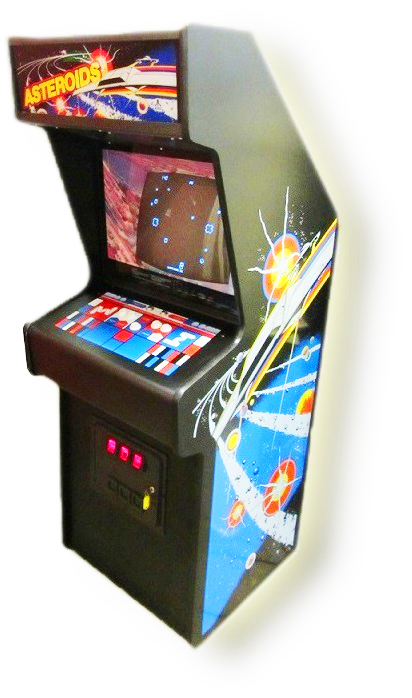
Asteroids was completed and released in November 1979.